
🏗️ Concrete Yard Calculator i
Professional concrete volume and material estimator
📋 Quick Reference
Thickness Guide
- Patio / Walk 4 in
- Driveway (cars) 4–5 in
- Driveway (trucks) 5–6 in
- Garage Floor 5–6 in
Bags / Cu Yard
- 80 lb bags ~45
- 60 lb bags ~60
- 40 lb bags ~90
Coverage @ 4 in
- 1 cu yd 81 sq ft
- 5 cu yd 405 sq ft
- 10 cu yd 810 sq ft
US Avg. Cost
- Ready-mix /yd³ $130–160
- Delivery fee $75–150
- 80 lb bag $6–8
Ordering too little concrete on pour day is the kind of mistake that haunts you. The truck leaves, your fresh slab is stiffening, and you’re scrambling for a second delivery that may not arrive in time. That cold joint running down the middle of your new driveway? It’s going to be there for decades.

The fix is simple — use a concrete yard calculator correctly before you ever pick up the phone to call your supplier. I’ve walked through concrete estimates with countless homeowners and contractors, and the difference between a smooth pour and a chaotic one almost always comes down to preparation. Let me show you exactly how these calculators work and how to use them like a pro.
Why Concrete Uses Cubic Yards (Not Square Feet)
Concrete fills three-dimensional space — it has length, width, and depth all working together. Square footage only captures two of those three dimensions, which is why suppliers can’t work with it alone.
The US concrete industry standardized on cubic yards as the unit of measure because it’s a practical size for batching, loading, and delivery. One cubic yard equals 27 cubic feet, roughly the size of a cube that’s 3 feet on every side.
When you ring up a ready-mix plant, they price per yard and batch per yard. A concrete yard calculator does the translation from your tape-measure numbers into the language your supplier needs.
How do I calculate yards of concrete?
To calculate yards of concrete, you first need to find the total volume of the area you want to fill. Start by measuring the length, width, and depth of the space in feet. Multiply these three numbers together to get the volume in cubic feet. After that, divide the result by 27, since one cubic yard equals 27 cubic feet.
For example, if a slab is 20 feet long, 10 feet wide, and 4 inches thick, convert the thickness into feet (4 inches = 0.33 feet). Then calculate:
20 × 10 × 0.33 = 66 cubic feet
66 ÷ 27 = about 2.44 cubic yards
It’s always wise to round up slightly and add around 5–10% extra to cover spillage, uneven ground, and small measuring differences. This ensures you don’t run short during the pour.
The Math Driving Every Concrete Calculator
All concrete calculators — regardless of how polished the interface looks — run this formula for rectangular areas:
Cubic Yards = Length (ft) × Width (ft) × Thickness (ft) ÷ 27
The single most common error people make is plugging thickness in inches without converting first. Four inches of depth is 0.333 feet (divide by 12). Six inches is 0.5 feet. If you skip that conversion and enter “4” into a field expecting feet, your estimate explodes by a factor of twelve.
Quick real-world example: A 12-foot by 20-foot patio at 4 inches thick. Convert: 4 ÷ 12 = 0.333 ft. Calculate: 12 × 20 × 0.333 ÷ 27 = 2.96 cubic yards. Round up, add your buffer — you’re ordering 3.25 yards.
Pro shortcut for 4-inch slabs: Divide your square footage by 81. That single step gives you cubic yards almost instantly. A 240-square-foot patio: 240 ÷ 81 = 2.96 yards. Same answer, half the steps.
For round shapes like post footings or columns, the formula shifts to: π × radius² × depth ÷ 27. A 10-inch diameter footing (radius = 0.417 ft) at 3 feet deep equals roughly 0.07 cubic yards per column. Small individually — but 15 footings adds up to over a yard.
How to Measure Your Project Accurately
Your calculator result is only reliable when the numbers going in are solid. Here’s how to measure each common project type without guessing.
Standard rectangular slabs — Stretch your tape from outside form edge to outside form edge. Record length and width in feet. For depth, measure at several spots across the area and average them. Subgrade surfaces are rarely perfectly uniform.
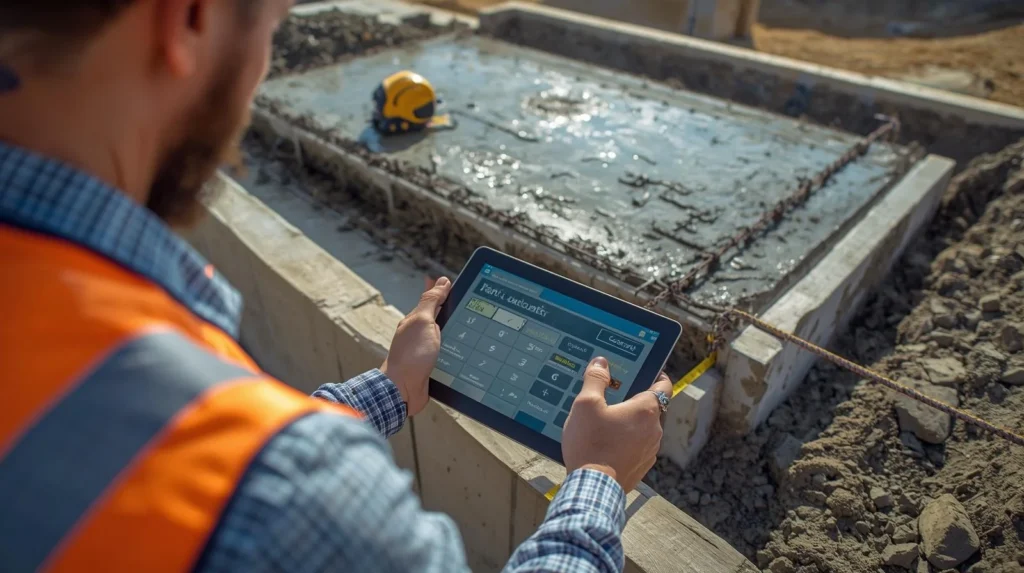
L-shaped or irregular areas — Sketch the shape on paper, split it into two or three rectangles, calculate each section separately, then add the volumes together. This approach handles almost any odd layout cleanly.
Footings — Multiply the total linear length of the footing run by its width and depth, all in feet, then divide by 27. A 100-foot perimeter footing at 16 inches wide and 12 inches deep: 100 × 1.33 × 1.0 ÷ 27 = 4.93 cubic yards.
Thickness Guide by Project Type
Thickness directly drives your cubic yard total — getting this number right is just as critical as measuring the surface area.
Patios and walkways — 4 inches is standard for foot traffic. Bumping to 5 inches near driveways or in freeze-thaw climates adds meaningful crack resistance with minimal extra cost.
Residential driveways — 4 to 5 inches for everyday passenger vehicles. If you park trucks, RVs, or anything with a loaded trailer, go with 5 to 6 inches. The additional material cost upfront beats premature cracking repairs by a wide margin.
Garage floors — 5 inches for standard use, 6 inches if heavy vehicles or equipment will be parked regularly. Adding fiber reinforcement to your mix order won’t change your yardage but dramatically reduces future cracking.
Deck and fence footings — Sized by your local building code, typically related to frost depth. A 42-inch-deep footing in the northern US is common. Calculate each column individually using the round formula, then multiply by your total count.
Bagged Concrete vs. Ready-Mix: Which One Fits Your Job
Once you have your cubic yard number, this decision becomes straightforward.
Bagged mix works well for projects under half a cubic yard — small post holes, isolated repairs, minor pads. You set your own pace, work in stages, and avoid minimum delivery fees. The tradeoff is physical effort. One cubic yard requires roughly 45 bags of 80-pound mix. That’s significant labor, and it compounds quickly as volume increases.
Ready-mix delivery makes sense for anything approaching 1 cubic yard and above. The concrete arrives already professionally batched, pours fast, and produces a more consistent finished product. Most suppliers require a minimum order — typically 1 cubic yard — plus a delivery charge. For medium to large pours, that cost is easily absorbed by the time and labor you save.
The gray zone sits around 0.5 to 1.5 cubic yards. Evaluate your site access, your physical stamina, and whether the delivery fee makes financial sense for your specific volume. Sometimes paying for the truck at a smaller volume is the right call — especially if you’re working alone.
Always Order More Than the Calculator Says
This is the rule every experienced concrete professional follows without exception — add 5 to 10 percent to your calculated volume before placing your order.
Real job sites don’t match perfect calculator assumptions. Subgrade dips consume extra material. Forms flex slightly under the weight of wet concrete. Some mix clings to chutes and equipment. Edge spillage happens on every job. These aren’t disasters — they’re just the reality of field conditions.
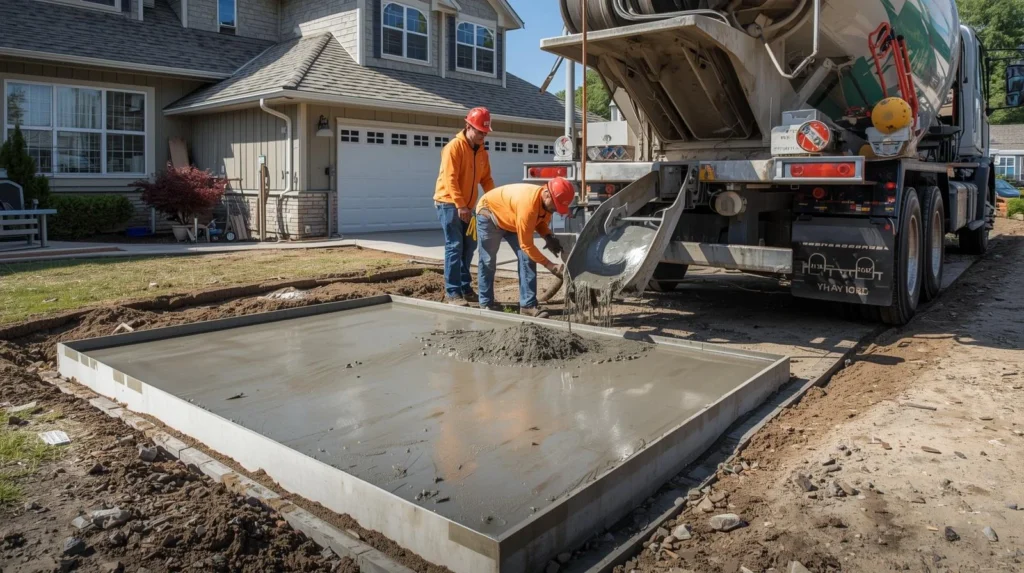
On a 5-yard order, a 10 percent buffer means ordering 5.5 yards. The cost difference is small. Having leftover concrete is a minor inconvenience. Running short mid-pour can create a cold joint — a permanently weakened seam where two separate batches meet — that compromises the structural integrity of your entire slab.
Order the buffer. Always.
Concrete Cost: What Your Yardage Means for Your Budget
Ready-mix concrete in the US runs between $130 and $160 per cubic yard on average, with meaningful variation by region. Delivery fees, short-load surcharges, and weekend premiums stack on top of the material cost. A 5-yard residential pour might run $650 to $800 in materials, plus $75 to $150 for delivery depending on distance and supplier.
Bagged concrete at retail prices costs roughly $6 to $8 per 80-pound bag. At 45 bags per yard, that’s $270 to $360 per cubic yard in materials — noticeably higher than ready-mix at any meaningful volume. For small projects, that premium is worth the flexibility. For larger pours, the math clearly favors the truck.
Get your yardage right first — then you can build a realistic budget around it.
Biggest Estimating Mistakes to Sidestep
Skipping the thickness conversion. Entering inches where feet are expected is the most common calculation error and the easiest to make. Always convert your depth before running any numbers.
Calculating for perfect conditions. A calculator gives you the volume of a theoretically perfect void. Your actual site has dips, bumps, and soft spots. Those imperfections eat concrete.
Ignoring supplier minimums. Some plants won’t deliver under 1 or even 2 cubic yards. Know this before finalizing your order so you’re not scrambling to adjust plans the morning of your pour.
Ordering to the exact number. If your result is 4.95 yards, ordering exactly 5 gives you nothing to work with if anything unexpected happens. Round up to the nearest clean increment your supplier accommodates.
FAQs About Concrete Yard Calculator
How many bags make one cubic yard?
Around 45 bags of 80-pound mix equals one cubic yard. For 60-pound bags, plan on approximately 60. Check the yield information printed on your specific bag brand since formulations differ slightly.
What thickness is right for a driveway?
Four inches handles standard passenger cars. Five to six inches is the smart choice for trucks, SUVs with heavy payloads, or RVs. When in doubt, thicker always ages better.
How soon can I walk on fresh concrete?
Light foot traffic is typically safe at 24 to 48 hours. Vehicles can use the surface around 7 days. Full design strength — what engineers reference — is reached at 28 days.
What is a cold joint and why does it matter?
A cold joint forms when fresh concrete is placed against a section that has already begun setting. The two batches don’t chemically bond the way a continuous pour does, leaving a potential weak point and water entry path. Ordering enough material to finish in one pour is the best way to avoid it.
Can I use a calculator for steps and walls?
Yes. Most online concrete calculators include options for steps, walls, and columns. Select the right shape type, enter the appropriate dimensions, and the tool handles the shape-specific geometry automatically.
The Bottom Line
A concrete yard calculator removes the guesswork from one of the most important decisions in any concrete project. Measure carefully, convert your thickness to feet, handle irregular shapes by breaking them into sections, and always build in that 5 to 10 percent buffer before you order.
Do those things, and pour day stops being stressful. It becomes just another step where everything goes exactly as planned.